
What Is a Capo? A Complete Guide to Using Guitar Capos
May 6th 2025
The Ultimate Guide to Using a Capo
Capos are one of the most important accessories a guitarist can own. Beginners and experienced musicians benefit from this simple but useful tool. Why should you have a guitar capo in your gig bag or toolbox? Strings and Beyond will answer this in our guitar capo guide that covers everything from its history to the many capo styles.
What Is a Capo?
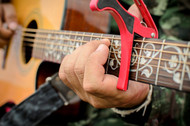
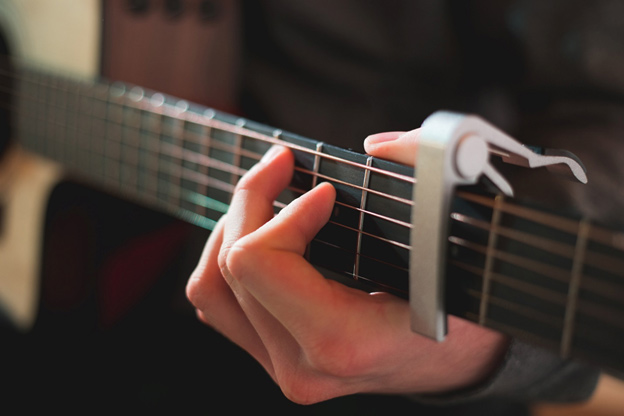
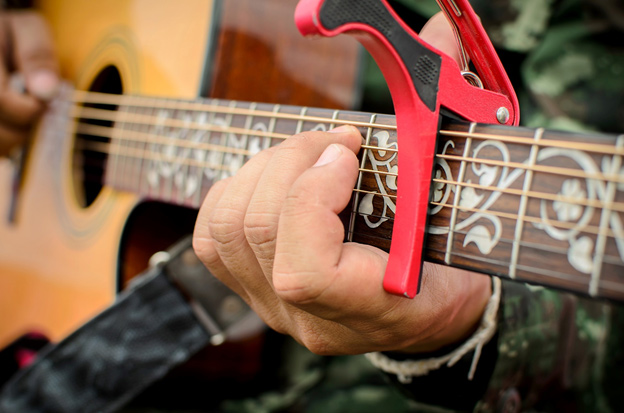
A guitar capo is a clamping device you place on the fretboard to anchor the strings at a different point than the headstock nut. This shortens the strings and changes the guitar’s pitch without re-tuning. This allows guitarists to use more comfortable finger positions and chord patterns to achieve their desired sound.
Origins and Etymology
The first capos developed in the mid-1700s were one-piece brass devices with a straight front and curved back to squeeze the neck. The word came from the Italian “capotasto” or “head”; musicologist Giovanni Battista Doni first used “capotasto” in 1640 to refer to the headstock nut on viol instruments. Late-1700s capo developments included the yoke capo, which was the first adjustable capo. It had a metal frame, a bar to fret the strings and a screw plate behind the neck to change the tension. There was also the Spanish cejilla, which was an upside-down yoke-style capo with a leather strap, wood bar and top-mount screw.
Connecticut luthier James Ashborn was the first person to patent a capo design in 1850. His capo also had a metal frame but used a wood fretting strip and a brass thumbscrew. Many more capos were patented in the coming years — there were even capos built into guitars. The most important, though. was W. H. Russell’s elastic capo released in 1931. The material’s natural tension secured the capo bar with no adjustments needed, and the low price made it accessible to more guitarists.
Practical Benefits of Using a Capo
There are many reasons why you can or should use a capo on your guitar. Consider some of the advantages of having a capo:
- The capo makes it easier to play certain songs by transposing chords, simplifying finger positions and avoiding barre chords.
- A capo gives songs a brighter sound and color by raising the pitch. They also create unique voicing and depth.
- Capos reduce the action on a guitar so less finger pressure is required, which is excellent for beginners and casual players.
- They let guitarist play open chords higher on the neck where the frets have closer spacing, which helps musicians with small hands.
Capo Chord Charts
Using a capo chord chart will help you understand the chord changes by visualizing the new open notes of each string. For example, you can see in a chart that a capo on the third fret (i.e., capo 3) will change an E chord to G, an Am chord to Cm, etc. Charts can also be based on individual strings and notes. Find a chart online or make one yourself to get used to the changes.
Types of Capos
Capo development has continued into the 21st century, and there are now many guitar capo types to choose from. Here are the five most popular capo styles and how they might suit your guitar needs.
Trigger Capo
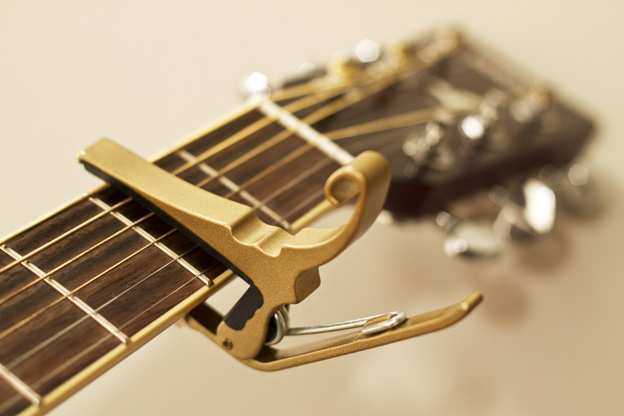
This popular capo has a durable plastic frame, a rubber fret bar, a padded top and a spring to clamp on the neck. Trigger capos are excellent for live shows because you can move them in seconds with one hand. The downside is that they sometimes apply uneven string pressure which can cause intonation issues and buzz.
Screw Capo
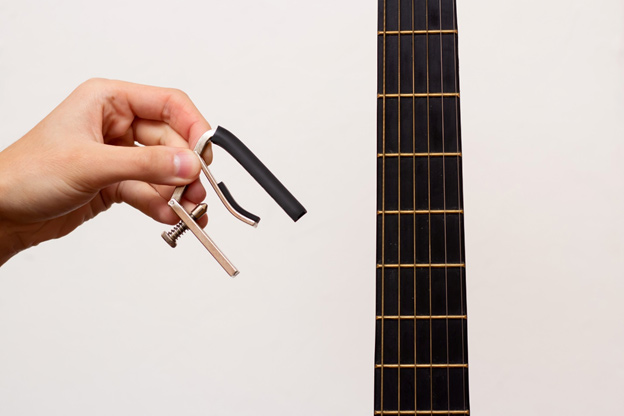
A screw capo is a modern yoke capo with a screw in the back that you tighten to add tension. They offer better tension distribution and tuning stability than trigger capos for recording and home practice. On the other hand, screw capos take much longer to reposition, making them less practical for the stage.
Roller Capo
This design has rollers in the front and back that let you shift the capo up and down the neck without removing it. Roller capos are the easiest to use, and you can even play while adjusting the capo, creating cool effects. However, they can cause tuning problems and tend to be expensive.
Strap Capo
These are derived from the Russell elastic capo with a bar to fret the strings and a strap you tighten around the neck. (The ratchet capo is a variation on this design.) Strap capos are the least expensive, but they are more likely to slip than other capos, and the strap will eventually lose its elasticity.
Partial Capo
A partial capo has a short front arm that only clamps some of the strings. This allows guitarists to quickly switch to alternate tunings and try unconventional sounds with simpler chord shapes. It will take some getting used to, but it offers unique sonic possibilities; partial capos are very popular for banjos.
The Capo’s Role in Music
We’ll close this guide with a look at how capos are used in the music scene. While capos are common in some genres, they are notably absent in others. Let’s get into where you’ll find them and why.
Popular Genres Using Capos
Capos are most popular in folk, flamenco and traditional Irish guitar music. You’ll also frequently encounter capos in blues, rock and country. The capo makes it easier to play open chords in different keys and adapt music to a singer’s vocal range. Capos also provide increased brightness, sharpness and resonance that are pivotal to the sound.
Capos in Jazz and Classical Guitar
Conversely, you seldom see a capo in heavy rock, metal, funk and disco. These genres emphasize power chords, complex riffs and fast tempos, all of which are harder to play with a capo shortening the strings. Capos are also rare in jazz and classical guitar because they hinder the frequent key changes, moveable chord forms and improvisation this music demands.
Famous Musicians and Their Use of Capos
Capos aren’t just for everyday musicians. Some of the world’s biggest artists have used capos to shape their sound and explore new horizons. Check out some of the most famous capo users:
- George Harrison loved his capos. The Beatles classic “Here Comes the Sun” achieves its brightness from a capo on the seventh fret, which was Harrison’s favorite positioning.
- Keith Richards combines capos with open tunings to give Rolling Stones’ songs a bluesier sound and tighter feel. You can hear this on songs like “Jumpin’ Jack Flash” and “Paint it Black.”
- Noel Gallagher is well-known for using a capo. “Wonderwall,” which many consider the signature Oasis song, is played with a capo on the second fret.
- Tom Petty often incorporated capos with his Heartbreakers and solo work. The iconic song “Free Fallin’” has two guitar parts with a first-fret capo and another with a third-fret capo.
- Bruce Springsteen often plays songs in the keys of Bb and Eb, and a capo lets him do so with resonant open chords. His most famous capo-ed songs include “Atlantic City”, “Dancing in the Dark” and “Land of Hopes and Dreams.”
- Dolly Parton sometimes utilizes capos, most notably in “Jolene”. The song has a capo on the fourth fret, producing the melancholy sound of the C# minor key with a simple chord progression.
Understanding the Capo's Place in Music
A capo allows all musicians to play songs in the correct key and get the sound they want without needing complex chord patterns and ultra-strong fingers. The devices have many applications in different genres and even give songs a distinct tonal feel. Experiment with capos in your playing and discover what they can do.