

Tips on Remembering the Order of Guitar Strings
Jun 13th 2025

4 Quick Ways to Remember Guitar Strings
Phrases to Memorize Guitar Strings
Now that you know what the strings are, the next step is committing their order to memory. A common trick for how to remember guitar strings is to use a phrase that has the string letters as an acronym. This memory technique is known as a mnemonic device. Phrases usually go from the top to the bottom string (E-A-D-G-B-E), though you can go from the bottom to the top string (E-B-G-D-A-E) if that’s what you prefer. There are hundreds of possible phrases already out there, and you can also create your own. Here are a few of our favorites to get you started.
E-A-D-G-B-E Guitar String Acronyms
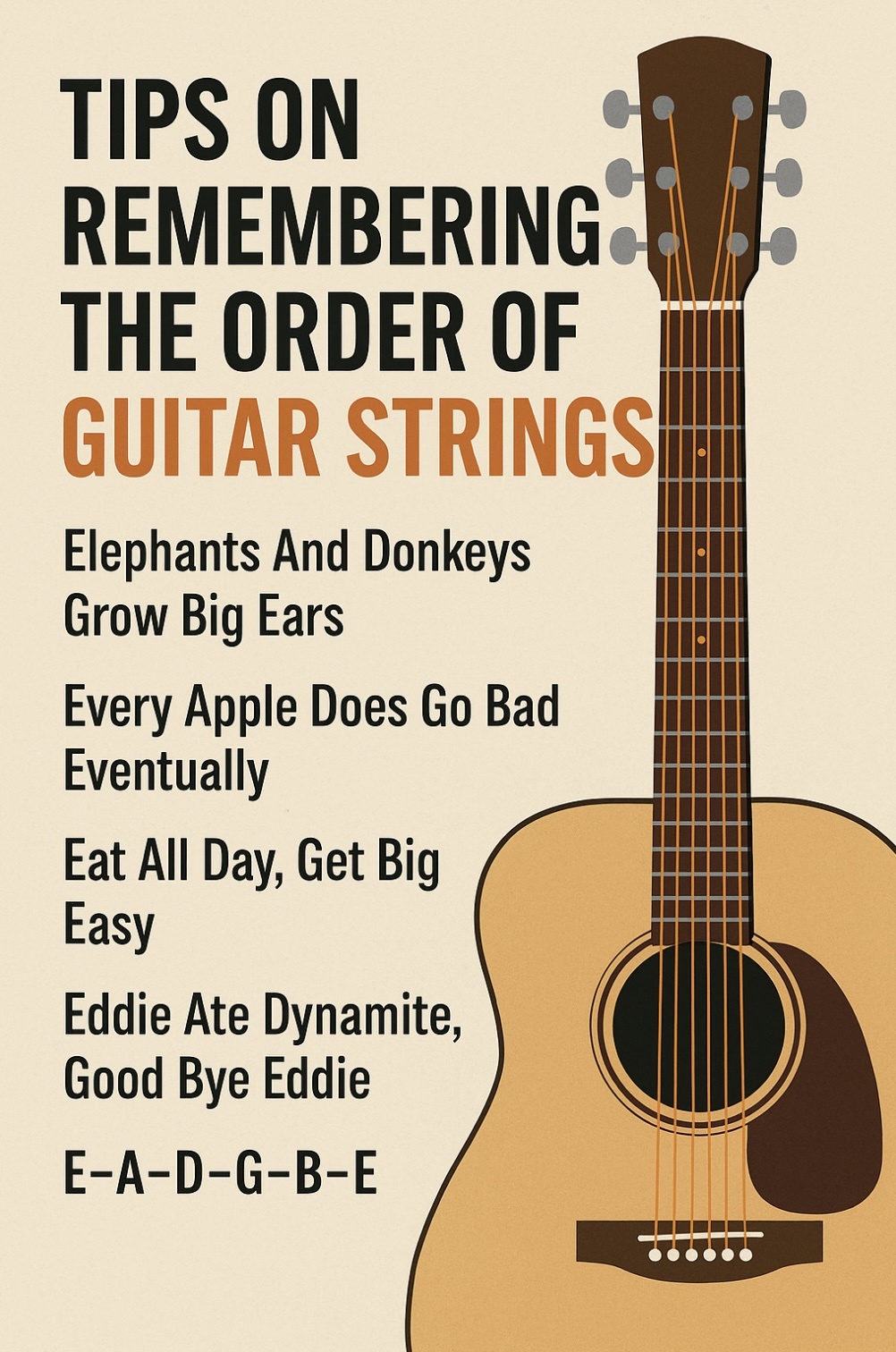
- Elephants And Donkeys Grow Big Ears
- Every Apple Does Go Bad Eventually
- Eat All Day, Get Big Easy
- Eddie Ate Dynamite, Good Bye Eddie
- Every Amp Deserves Guitars/Basses Everyday
E-B-G-D-A-E Guitar String Acronyms
- Elvis’ Big Great Dane Ate Everything
- Every Boy Gets Dinner At Eight
- Every Banana Gets Digested After Eating
- Every Bad Girl Does All Evil
Understanding Standard Guitar Tuning (E-A-D-G-B-E)
Are you better with numbers than letters? You’re in luck — each guitar string has a corresponding number. So, instead of naming them, you can count them.
Standard tuning refers to the default pitch assigned to each of the six strings on a guitar, from lowest (thickest) to highest (thinnest):
Furthermore, the lute and oud — the string instruments the guitar evolved from — were held upright, and thus the string numbering logically went left to right.
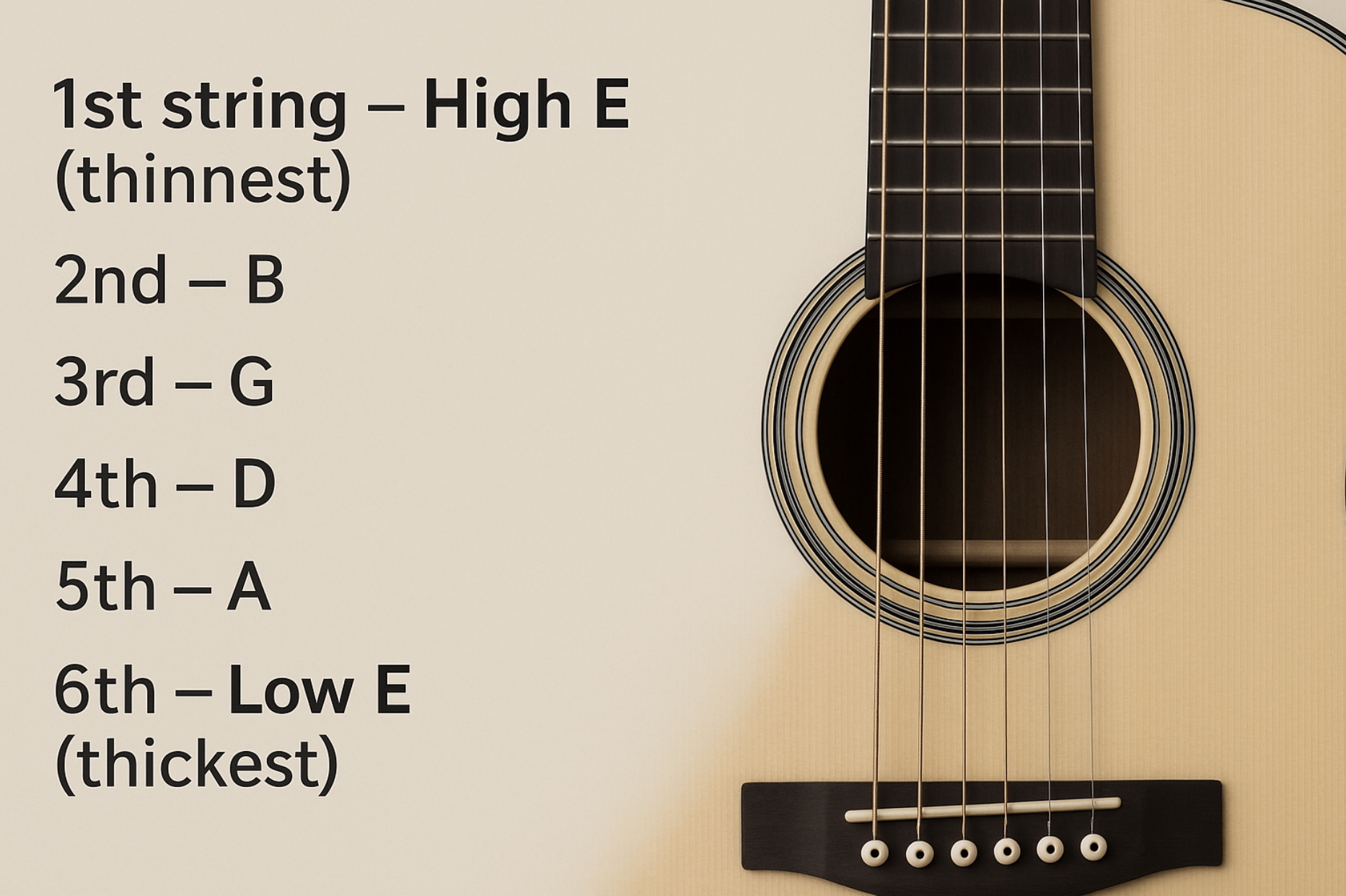
Visually, when holding your guitar, the 6th string (low E) is physically closest to you, and the 1st string (high E) is furthest away. The tuning goes up in pitch as you move from the 6th to the 1st string.
Why Is This Tuning Used?
This E-A-D-G-B-E arrangement has been used for centuries because it strikes a perfect balance between:
- Chord playability
- Fretboard navigation
- String tension and tone
The intervals between strings are:
- Perfect fourths (5 semitones) between E–A, A–D, D–G, and B–E
- A major third (4 semitones) between G–B
This exception (G to B) makes traditional chord shapes easier and more compact.
Tips on Remembering the Order of Guitar Strings
One of the first things you should learn when playing guitar, from acoustic to electric, is what order the guitar strings are in. We know what some of you are already thinking: “I don’t want to think, I just want to play.” Or “I don’t need to know the string order — I have a great ear.” But when you’re jamming at rehearsal and someone says, “Hey, your D-string sounds a tad flat,” or “Can you play fret seven on the B-string,” and you have no idea what to do, you’ll be wishing you had put the time into learning them. Let’s review the guitar string order and the ways you can make it second nature.
Use a Guitar String Tuner for Repetitively See Each String Name
Every guitarist should own a tuner to make sure their strings are on the right note. This accessory is also a great way to ingrain the string names. The tuner will display what note you’re playing, meaning you’ll see the correct note every time you’re in tune. Some tuners can even be programmed to only display a certain string note, making it much harder for newbies to tune to the wrong note. (You can also get tuner apps for your smartphone; we recommend having both a regular tuner and an app in case you forget one or the battery dies.)

Test Yourself Often on Each Guitar String Name
The most direct way to memorize your guitar strings is simple: every time you pick up the guitar, point to a string and say its name. If you’re picking up the guitar regularly — and you should be if you’re a serious player — you’re going to get lots of practice. Not only are you working on learning the strings you don’t know, but you’re making sure the ones you do know are deep-seated in your mind. Once you can name all the strings in order, try naming them out of order.

Wrapping Up: Some Simple Ideas Can Help You Remember the Order of Guitar Strings
Whether you’re a first-time guitar player or just realized you were long overdue to learn the string names, we hope this guide was helpful to you. As bonus, this knowledge will make it much easier to change your guitar strings and purchase single strings. Happy playing, and remember: Every Amateur Does Get Better Eventually.

What are the Different Guitar Strings?
Before remembering the guitar string order, you need to know what you’re remembering. Since the early 19th century, the six-string guitar has been the most popular. The standard tuning of these strings is E-A-D-G-B-E, going from the top string — the one closest to you when you’re playing — to the bottom string. Going from top to bottom, each string is five half-steps (i.e. a perfect fourth) higher than the previous spring except for the jump from G to B, which is four half-steps (i.e. a major third).
This string tuning method is believed to go as far back as far as the 16th century when the five-string Italian folk guitar was developed. The “chitarra battente” had a tuning of A-D-G-B-E with no bottom E string. How come? The simple answer is that centuries of experimentation concluded this was the easiest, most ear-pleasing way to play full chords. Though you technically can use an all-fourths tuning of E-A-D-G-C-F (and some people do), your fingers would have to stretch in weird ways to play most standard chords. And barre (pronounced “bar”) chords — a chord with no open strings — would be next to impossible.
Other types of guitars and tunings are available, including seven-string guitars, eight-string guitars and baritone guitars. However, for this discussion, we will focus on the standard six-string tuning. The same principles apply to the standard four-string bass guitar, which uses the same tuning as the top four guitar strings (E-A-D-G) only down an octave.